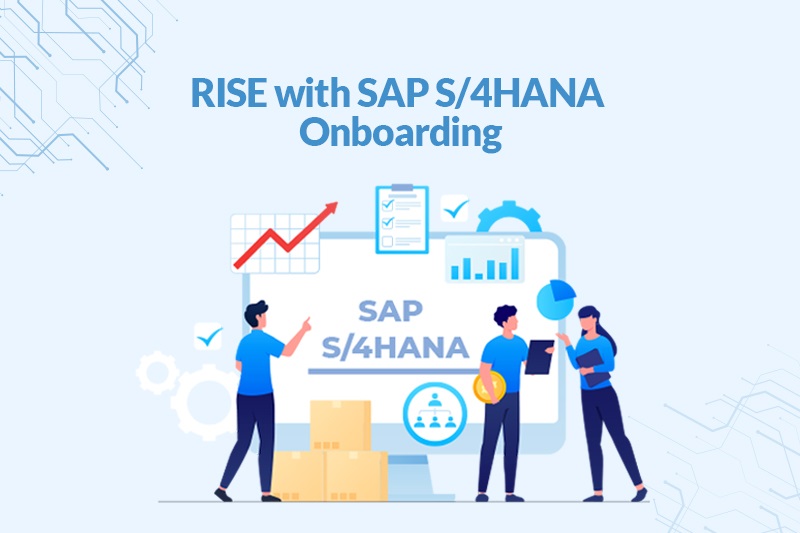
SAP’s flagship S/4HANA Cloud has vaulted from trend to table-stakes for enterprises and ambitious midsize players alike. Built on the in-memory SAP HANA® database and delivered “ever-green” via the RISE with SAP program, it promises an intelligent, composable, and perpetually current ERP backbone. Below is a 360-degree, field manual—covering essentials from business case to go-live stabilization—so you can ride the wave instead of paddling behind it.
1. Why the Market Is Shifting—Fast
- Pressure for Real-Time Decisions – Supply-chain shocks and inflation volatility punish hour-old data. S/4HANA’s in-memory engine delivers sub-second analytics on live transactions.
- Cloud Economics – OPEX subscriptions replace CAPEX data centers; quarterly innovations drop automatically.
- Regulatory Dragnet – Continuous e-invoicing, ESG reporting, and cyber mandates demand a platform that updates faster than lawmakers legislate.
- Talent Dynamics – Gen Z IT pros want API-driven, SaaS-native stacks, not six-letter transaction codes from 1995.
SEO keywords: SAP S/4HANA Cloud, intelligent ERP, RISE with SAP, in-memory analytics, cloud ERP adoption.
2. Deployment Options in Plain English
| Option | Best For | Key Traits |
| Public Edition | Net-new or “greenfield” transformation | Multi-tenant SaaS, quarterly upgrades, fit-to-standard processes |
| Private Edition (RISE) | Brownfield conversions or heavy custom code | Single-tenant, annual upgrades, full data isolation |
| On-Premise (“Any Premise”) | Regulatory or latency constraints | Traditional install on HANA hardware; customer-managed |
(The RISE with SAP commercial wrapper can bundle any edition with hyperscaler hosting, SAP BTP credits, and business process intelligence.)
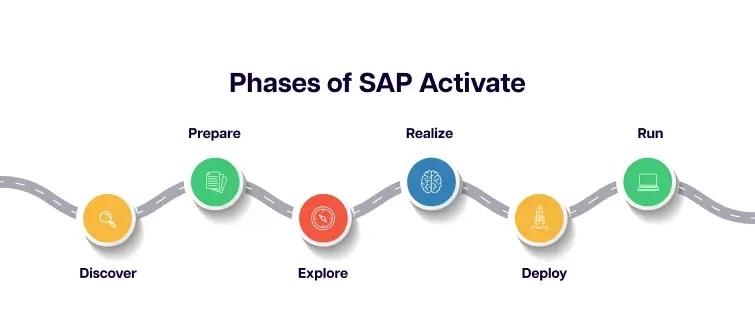
3. The SAP Activate Methodology—Your Flight Plan
- Discover – Business case, value drivers, high-level roadmap (2–4 weeks).
- Prepare – Project charter, provisioning, fit-to-standard workshops (4–6 weeks).
- Explore – Detailed process design, configuration in starter system (8–12 weeks).
- Realize – Build, data migration, extensions, test cycles (12–20 weeks).
- Deploy – Cut-over rehearsal, hyper-care, hand-over (2–4 weeks).
- Run & Optimize – Quarterly release management, KPI mining, continuous improvements (forever).
Pro tip: Hug the “fit-to-standard” mantra; bolt-on differentiators via SAP Business Technology Platform (BTP) instead of hacking the core.
4. Data Migration—Where Projects Live or Die
- Cleanse first, migrate once. Load only active customers, vendors, and materials.
- Use SAP Data Migration Cockpit for templates, mapping rules, and load simulation.
- Parallel ledgers? Leverage Universal Journal (ACDOCA) to merge FI and CO in a single table—dramatic simplification for finance teams.
- Cut-over window: Execute rehearsal cycles until the team can run convert, validate, and reconcile inside the allotted blackout.
5. Security & Compliance as Built-In, Not Bolt-On
- Zero-trust posture: Role-based authorizations plus identity federation to Azure AD/Okta.
- Data residency & sovereignty: Choose hyperscaler regions that satisfy GDPR, Saudi PDPL, or China CSL.
- Continuous control monitoring: Embedded GRC Access Control and Continuous Control Review apps flag segregation-of-duty violations in real time.
6. Exploiting the Big Strengths
a. Embedded Analytics & KPIs
- SAP Fiori cards and SAP Analytics Cloud (SAC) stories sit on transactional tables—no ETL lag.
- Build “plan-to-actual” dashboards that finance closes in days, not weeks.
b. Intelligent Automation
- SAP Build Process Automation delivers low-code bots; auto-match 3-way invoices or predict late deliveries via machine learning.
- Situation Handling nudges users with contextual alerts instead of email spam.
c. Industry Best Practices
- Over 25 pre-configured packs—automotive, consumer products, utilities—accelerate compliance and shorten design workshops by 30 %.
d. Extensibility Without Technical Debt
- Key-user in-app tools for fields, logic, or forms.
- Side-by-side apps on SAP BTP (Node.js, Java, Python) connect securely via OData and Event Mesh; stay safe during quarterly upgrades.
e. Continuous Innovation
- Quarterly release cycles sprinkle AI, sustainability, and UX goodies without disruptive re-platforming projects.
- Feature toggle lets you pilot new capabilities on select users before global rollout.
7. Change Management—The Human Multiplier
- Persona-based training—finance, planner, sales—in bites, not marathons.
- Digital adoption platforms (Enable Now, WalkMe) overlay click-through guidance.
- Gamify KPIs—leaderboards for clean goods-receipt postings or on-time approvals.
- Executive storytelling—link dashboards to revenue, cashflow, ESG wins.
- Hyper-care SWAT team—business and IT co-staffed; SLA < 30 min for Priority 1 tickets the first four weeks.
8. Measuring Success—What the CFO Wants to See
| KPI | Pre-S/4 | Target 1 Year Post Go-Live |
| Days Sales Outstanding | 64 | < 50 |
| Inventory Turns | 4.2 | > 6 |
| Finance Close Cycle | 10 days | 3 days |
| IT Cost to Revenue | 2.8 % | 2.1 % |
| ESG Reporting Cycle | 3 weeks | Real-time |
Tie each KPI to an executive owner and review in Quarterly Value Steering sessions.
9. Common Pitfalls and How to Dodge Them
| Pitfall | Antidote |
| Over-customization of core | Enforce “no ABAP in core” policy; use BTP. |
| Data swamp migration | Freeze legacy archiving six months before extract. |
| Scope creep mid-project | Lock scope at Explore; push nice-to-haves to Release 1.1. |
| Ignoring integrations until test cycle | Stub APIs in sandbox; validate EDI, payroll, e-invoice early. |
| Treating cloud as Capex | Align finance on OPEX budgeting and IFRS 16 lessee accounting. |
10. Post-Go-Live Optimization Loop
- Quarterly release readiness checks (sandboxes open 3–4 weeks prior).
- Process mining via SAP Signavio: discover bottlenecks, simulate fixes.
- Finance first: adopt Group Reporting and Central Finance for faster consolidation.
- Leverage RISE credits: spin up predictive maintenance or sustainability control tower proofs of concept.
The Strategic Payoff
Migrating to SAP S/4HANA Cloud isn’t an upgrade—it’s a pivot to an intelligent enterprise platform where speed, insight, and resilience compound. With fit-to-standard discipline, automated controls, and extensibility on SAP BTP, organizations cut technical debt, shrink operating costs, and gain the agility to launch new business models—subscription services, direct-to-consumer channels, or carbon-neutral supply chains—without a re-implementation marathon.
Humor checkpoint: “Think of S/4HANA Cloud as swapping a map-folding rally car for a self-driving electric racer that updates its track data while you sip espresso.”
Book a “Transformation Readiness Sprint”
Ready to explore your path? Engage an SAP-certified partner for a two-week Readiness Sprint: business case modeling with SAP Value Lifecycle Manager, high-level architecture on your hyperscaler of choice, and a phased migration roadmap complete with cost, timeline, and KPI targets. Your race to real-time resilience starts with one pit-stop.
Deploy once, innovate forever—welcome to the era where ERP upgrades itself and your data finally moves at the speed of strategy.